
Video: One Fast-Moving Tom

TRCP’s Neil Thagard and his wife Catherine recently had the opportunity to enjoy some time on public land chasing Merriam’s turkeys. With Catherine behind the camera and Neil as the caller and shooter, they were able to coax this wily tom away from his hen into their decoy setup, which resulted in a 25 yard shot – enjoy the video!

Wednesday Win: T.R.ivia

Photo courtesy of the Library of Congress.

How well do you know Roosevelt? Give our trivia challenge a try. 

What family member accompanied T.R. on his African safari?

Leave us a comment on the TRCP Blog, or email your answers to info@trcp.org by Friday for your chance to win a copy of the first season of the Sportsman Channel’s “MeatEater” featuring Steven Rinella.

Ten Tips for Renewable Energy Development on Public Land

Turbines at Foote Creek

Photo courtesy of Ed Arnett.

Chances are that most sportsmen do not spend much time thinking about energy development. But whether you know it or not, hunters and anglers have much at stake when it comes to our energy resources, including renewable sources such as wind.

As head of the TRCP’s energy program, it is my job to carry the sportsman’s voice in the energy development processes. My objective in this is clear: to ensure our nation’s energy needs are balanced with those of sportsmen.

Sportsmen should be encouraged that renewable resources like wind have shown so much promise. With clean-up still underway on the tail of the three-year-anniversary of the BP oil spill, many in the conservation community are encouraged by the forward momentum on renewable resources.

The concern for sportsmen is that the rush to develop and bring renewable energy resources to the market will negatively impact fish and wildlife and result in loss of access for hunters and anglers.

As with traditional forms of energy development like oil and natural gas, renewable resources must be developed and implemented with what the administration calls a “smart from the start” mentality. The TRCP, along with Trout Unlimited and the National Wildlife Federation, head up the Sportsmen for Responsible Energy Development – a coalition dedicated to bringing balance to oil and gas development.

SFRED lays out 10 considerations for developing renewable energy on public lands. They are as follow:

  1. Give sportsmen a voice in decision making.
  2. Protect roadless backcountry, National Parks, National Wildlife Refuges and local and state public lands.
  3. Conserve important fish and wildlife habitat.
  4. Consult with state fish and wildlife officials first.
  5. Rely on the latest science.
  6. Strengthen the permitting and leasing process.
  7. Monitor impacts to fish, wildlife and water.
  8. Mitigate damage and reclaim affected land and water.
  9. Comply with all relevant environmental laws.
  10. Hold industry accountable for development costs.  This includes monitoring and mitigation costs.

When applied, these principles ensure that renewable energy development can be compatible with the needs of fish, wildlife and hunters and anglers.

The TRCP’s energy program will continue to carry the sportsman’s voice in land-use planning and policy debates so that all forms of energy are balanced. We will call on you to speak up when it matters.

Watch the video below and visit the Sportsmen for Responsible Energy Development website to learn more.

Happy Mother’s Day from the TRCP

The Cost of Conservation

Money

Behind every thrilling hunting tale are the policies and politics that govern how, when and where we can pursue our passions.

When people learn I work in conservation, it often elicits responses of “that must be exciting!”  Truly, sometimes it can be.  More often though, the issues that the TRCP deals with on a daily basis, those  that have the greatest impact on hunting and fishing, are not the thrilling “in-the-field” projects people envision.

Take the subject of conservation funding for example – this is something every sportsman should be concerned about.  However, when I mention it to many avid hunters or anglers, I receive a glazed expression and a swift change in the conversation.

Federal funding for wildlife conservation is an integral part of our economy and allows resource managers to sustain fish and wildlife habitats and sporting opportunities. Since 2011, there has been a frenzy of budget cutting and deficit-focused politics in Washington, DC and unfortunately, federal funding to fish and wildlife conservation programs have taken a disproportionate hit. As a result, many natural resource agency budgets have also been slashed, and my home state of Wyoming is no exception.

Facing a budget shortfall of $7 million, mostly due to increasing costs with no additional revenue, the Wyoming Game and Fish Department recently proposed license and tag fee increases – a measure which was not supported by sportsmen. It’s easy to see why; nobody wants to pay more, especially in these tough economic times. However, I suspect that had more of Wyoming’s hunters and anglers been educated about conservation funding, what it provides and the potential ramifications of a lack of funding, they would have supported the proposed fee increase.

Wyoming sportsmen are about to lose much more than the extra $17.00 it would have cost for a resident antelope tag or $14.00 for an annual fishing license. The proposed budget reductions will have a direct impact on the places we hunt and fish, most importantly the loss of public access through easement reductions on private lands. There is also going to be less game to chase and fewer fish to catch, as Wyoming is losing both wildlife biologists and habitat improvement projects (which will affect future wildlife numbers). By 2014 there will be more than 600,000 fewer fish stocked in our reservoirs annually.

However the losses that will potentially have the greatest long-term impact are the cuts to youth programs. The Wyoming Hunting and Fishing Heritage Expo – a program essential to introducing school age Wyomingites to safe outdoor recreation and the value of wildlife conservation will be cancelled. Department support for the National Archery and Fishing in Schools programs is also disappearing.  Without future generations being responsibly introduced to hunting and fishing, declining sportsmen’s numbers are inevitable.

Wyoming sportsmen are no doubt going to weather the challenges resulting from their current conservation funding crisis, but this situation is not limited to the Cowboy State. As belts continue to be tightened nationwide we all need to remember that activities related to hunting and fishing have a significant economic impact, the sporting community is part of an outdoor recreation economic sector that generates more than $1 trillion for the U.S. economy every year.

All sportsmen have the obligation to become engaged in more than just the aspect of hunting that rolls around each spring and fall. Behind every thrilling hunting tale are the policies and politics that govern how, when and where we can pursue our passions. We cannot afford to be apathetic when it comes to the less exciting aspects of hunting or fishing; conservation-minded sportsmen must actively support legislation that provides adequate and stable funding for conservation programs to ensure that we all have quality places to hunt and fish, both now and for the future.

We Can Do Better

Normally I post deep thoughts about matters of conservation policy. Today I will rant.

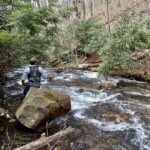
Just over a week ago I met two friends, packed up the car in Washington, D.C., and headed for Pennsylvania’s Little Juniata River, one of the best trout rivers in the East. The fabled Grannom caddis hatch was on, and it had been six months since I’d stood in a river chasing trout.

As has been my tradition for most of the last 15 years, we left town early to hit Spruce Creek Outfitters, an excellent fly shop where we could buy licenses, stock up on the latest bugs and hear fish tales before hitting the river for the afternoon. Unfortunately, the fly shop no longer sells licenses. Instead they told us to use our smart phones to buy the licenses online.

We set off for a high spot on the road where we could get cell service. After about 30 minutes, my friends succeeded in their efforts. I was unable to complete the transaction but decided to put my friends on the river and then complete my purchase at some other high point along the river.

After sending off my friends, I again found a spot with service and tried to purchase my license, each time reaching the final stage (after entering my credit card information) before receiving the message that the server was busy and to try again later. About 15 minutes into this process I called the toll-free help line and was put on hold to wait for the next available agent. Surely, I thought, between my continued efforts with the Pennsylvania website and help from a live person, I would succeed.

Nearly an hour later I had yet to speak to an agent and was still without a license.

Approaching a murderous rage, I gave up, drove back to the river, put on my waders and walked out to live vicariously through my friends, watching them catch fat brown trout on dry flies. After dinner that night I was finally able to complete my transaction and fish the next day.

Across America, conservation groups work to get kids outdoors and pass along the traditions of hunting and fishing. The Recreational Boating and Fishing Foundation spends millions of dollars encouraging people to rejoin fishing or try it for the first time – and with remarkable success. According to the U.S. Fish and Wildlife Service, participation was up 11 percent in the last five years, reversing a 20 year decline.

Photo by, Dusan Smetana

To ensure that we have quality places to hunt and fish, conservation groups also are restoring our lands and waters. Look no further than the Little Juniata, which 40 years ago was an open sewer devoid of most fish life.

Groups like the TRCP work to implement new programs, like the Open Fields program of the Farm Bill, to open private lands and waters to hunting and fishing. Since Open Fields launched in 2010, approximately 3 million acres have been opened to the public.

All this work on engagement, habitat and access falls by the wayside if sportsmen must struggle to obtain the proper licenses and tags. The responsibility for licensing falls to the states. According to a recent RBFF study, only five of the 50 states offer mobile friendly websites and only two of the 50 states offer mobile friendly license sales.  Really?

Folks, our sports depend upon participation. Fish and game agency budgets depend upon license sales. Conservation groups depend upon engaged members who will work like dogs for the resource but who deserve to be able to enjoy that resource with as little hassle as possible.

I’d like to think of my experience with the Commonwealth of Pennsylvania as an exception, but the RBFF numbers indicate otherwise. We can do better, and all sportsmen and -women should make sure that their states join the 21st century and make it as easy as possible for people to enjoy their resources.

Former Aide to Colo. Sen. Udall Becomes Advocate for Conservation Group

Story courtesy of E&E News

Scott Streater, E&E reporter

Published: Friday, May 3, 2013

The Theodore Roosevelt Conservation Partnership today announced the hiring of a top aide for Colorado Sen. Mark Udall (D) to lobby on water resource issues on Capitol Hill.

Jimmy Hague had been Udall’s primary adviser the past four years on various conservation and natural resources issues, focusing among other things on water and conservation sportsman issues, said Mike Saccone, Udall’s spokesman in Denver.

Saccone said Hague was instrumental in helping Udall work with U.S. EPA to clarify liability protection for independent groups that pitch in to help clean up the thousands of abandoned hardrock mines that litter the landscape across the West.

EPA in December released a memorandum clarifying that so-called good Samaritan groups don’t need a Clean Water Act permit for certain discharges connected to abandoned mine cleanups under the federal Superfund law. That move came after years of lobbying by conservation advocates and supportive lawmakers like Udall and fellow Colorado Sen. Michael Bennet (D) (E&ENews PM, Dec. 12, 2012).

Hague this week took over as director of the newly established TRCP Center for Water Resources and will be working to advance policies addressing water scarcity issues and the federal role in water management, allocation and conservation in Washington, D.C., the group announced today.

“I am thrilled to be joining the talented and dedicated team at the TRCP,” said Hague, a West Virginia native who received a master’s degree in environmental policy from the University of Colorado, Boulder.

“The TRCP recognizes the importance to the hunting and angling communities of comprehensive, forward-thinking water resources management. Our shared water challenges impact all of our conservation efforts and will do so even more as climate change and population growth exacerbate our immediate water problems,” he added. “I look forward to leading the TRCP’s efforts to find pragmatic solutions to the problems facing our most precious natural resource.”

TRCP’s conservation policy agenda released in January highlights a commitment to water policy issues, which it says in the document is “a new policy area for 2013″ and “one of the most important issues facing the conservation community and the country.”

Hague will help guide TRCP’s Water Working Group, which among other things will provide a forum to examine water quality and quantity issues associated with hydraulic fracturing. The working group includes Trout Unlimited, the Nature Conservancy and the American Sportfishing Association.

The addition of Hague is part of an effort by TRCP to expand its influence on water policy issues in Washington that affect the conservation and sporting communities.

Along those lines, TRCP also announced that Steve Kline has been appointed TRCP director of government relations and is overseeing the development and implementation of TRCP’s advocacy efforts both on Capitol Hill and in the executive branch. Kline was director of the TRCP Center for Agricultural and Private Lands.

Kline also managed TRCP’s work on the Clean Water Act, which Hague is now taking over, the group announced.

“We’re thrilled to have Jimmy join the TRCP team and to have Steve expand his role within the organization,” TRCP President and CEO Whit Fosburgh said in a statement. “These two policy experts have the knowledge, experience and personal qualities to leverage the power of our partners — in support of legislative solutions that support fish and wildlife conservation and that advance the interests and values of hunters and anglers everywhere.”

VIDEO: QUARTERING AND PACKING BIG GAME

Many folks feel overwhelmed when they are hunting on public lands and they get a deer or elk down on the ground in a place that is a mile or more from the nearest road. At this distance, dragging an animal out is too much work and game carts are often impractical.

If, like most folks, you don’t have the luxury of owning livestock, you need to pack the animal out on your back. To do so, you must understand how to quarter an animal into manageable, packable pieces.

Watch and learn as Steven Rinella outlines the basic steps for getting the job done.

The TRCP and Guns

Now that the gun debate in Congress has died down, I wanted to address those questions that we got along the lines of “why hasn’t the TRCP taken a position?”

The TRCP was created in 2002 with a very focused mission: to guarantee all Americans quality places to hunt and fish. Our mission has been reaffirmed over the years and is being done so again this year.

Gun owners are very effectively represented in Washington, D.C.; what was lacking before the TRCP was a single organization to pull together the disparate voices of the hunting and fishing community to work together on issues related to conservation and access.

Roosevelt in Africa on horse with gun

Image courtesy of U.S. Library of Congress.

Very simply, others know far more than we do about the Second Amendment, not to mention school safety, the mental health system, weapons trafficking and other key components of the gun-violence debate today.

Mission drift is a concern for all organizations. That is why they create missions, visions and strategic plans to guide their actions.

The range of conservation issues in which the TRCP does engage is diverse and represents the interests of the millions of hunters and anglers in this country. From water quality, private lands conservation and marine fisheries management to responsible energy development and conservation on federal public lands, the TRCP works collaboratively with our partners to develop smarter natural resource policies – policies that promote the conservation of fish and wildlife and their habitat, increase funding for responsive resource management and enhance public access for sportsmen.

There are a few issues important to sportsmen (in addition to the Second Amendment) that fall outside our organization’s charter. We do not engage in youth education efforts, in large part because so many of our partners, from the National Wild Turkey Federation to the International Hunter Education Association, do such a great job at this work.

We don’t do on-the-ground habitat conservation projects. That’s already being done by Ducks Unlimited, Trout Unlimited, Pheasants Forever and many others. And we don’t do electoral politics – we don’t have a political action committee and we remain fiercely nonpartisan. In short, we focus on what we do best: advocating for habitat, funding and access.

It is worth noting the important role that hunters and anglers play in funding conservation in America.  For more than 75 years, the Pittman-Robertson Act, which created an excise tax on guns and ammunition sales, has thrived, providing more than $6.5 billion to state fish and wildlife agencies.

As sportsmen, our priority should be to ensure the successful continuation of funding for key conservation programs. Not only are such programs critical for fish and wildlife habitat, they make good economic sense. This is a point we have stressed to Congress and the administration since the TRCP was created, including during the gun debate.

While the gun control debate has dominated the recent news cycle, conservation, funding and access continue to demand our attention and advocacy – and will do so well into the future. The TRCP will remain at the forefront of these issues and will persevere in our efforts to uphold opportunities to hunt and fish for this generation and those that follow.

Caption Contest via ‘The Utah Bucket List’

The fine folks working on “The Utah Bucket List” posted the following photo on their Facebook page. Post your caption below. We will send the winner a book bundle including TRCP favorites, “MeatEater, Adventures from the Life of an American Hunter” and “Last Stand: Ted Turner’s Quest to Save a Troubled Planet.”

Submit your best caption by Friday. We will announce the winner at noon EDT.

Happy captioning!